AML Provider Overview: Who to Choose and How
18/02/2026
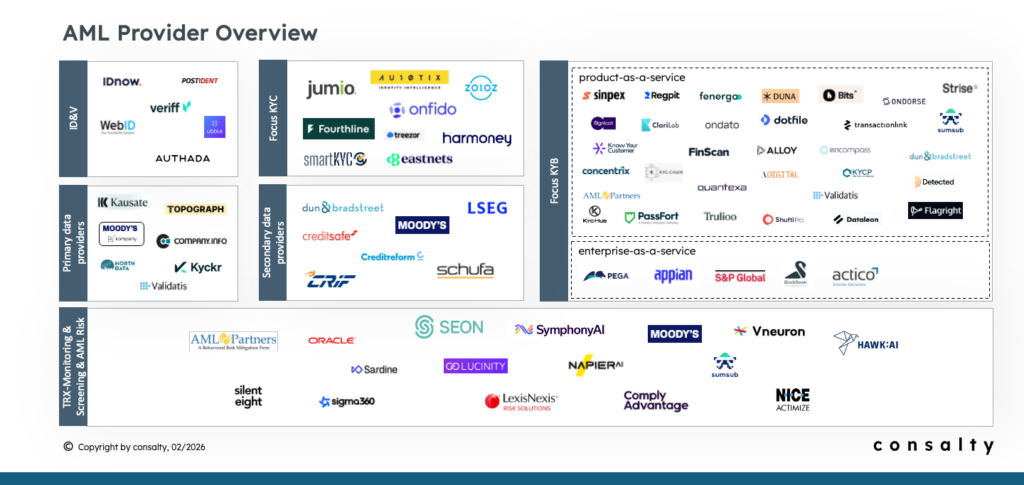
Shopping for AML technology in Europe feels like navigating a labyrinth. The market is fragmented and crowded with dozens of service providers offering overlapping functionality under different labels. Try searching for „KYC providers“ on Google – the first page shows results from completely different service categories. If you don’t know exactly what you’re looking for, you’ll be lost.
From „KYB automation“ to „risk engines“ or „compliance orchestration“, there’s no consistent terminology – and that inconsistency makes selecting the right partner increasingly difficult for compliance teams.
The confusion starts with basic definitions and requirements:
- KYB ≠ KYC: Know Your Customer, Know Your Business and Know Your Transaction are fundamentally different services – yet often bundled under one label.
- Engines, workflows, orchestration – what do you really need? Risk engines, workflow engines and orchestration platforms all sound compelling, but which components do you actually require?
- Operating across jurisdictions? That implies different registries, legal forms, documents, data models – make sure your AML provider truly understands the requirements in each country.
A lack of common standards doesn’t just complicate vendor comparisons; it also creates real operational risks when institutions misalign a provider’s capabilities with their internal needs.
To cut through the confusion, we’ve mapped the European AML service provider landscape – see the download section above.
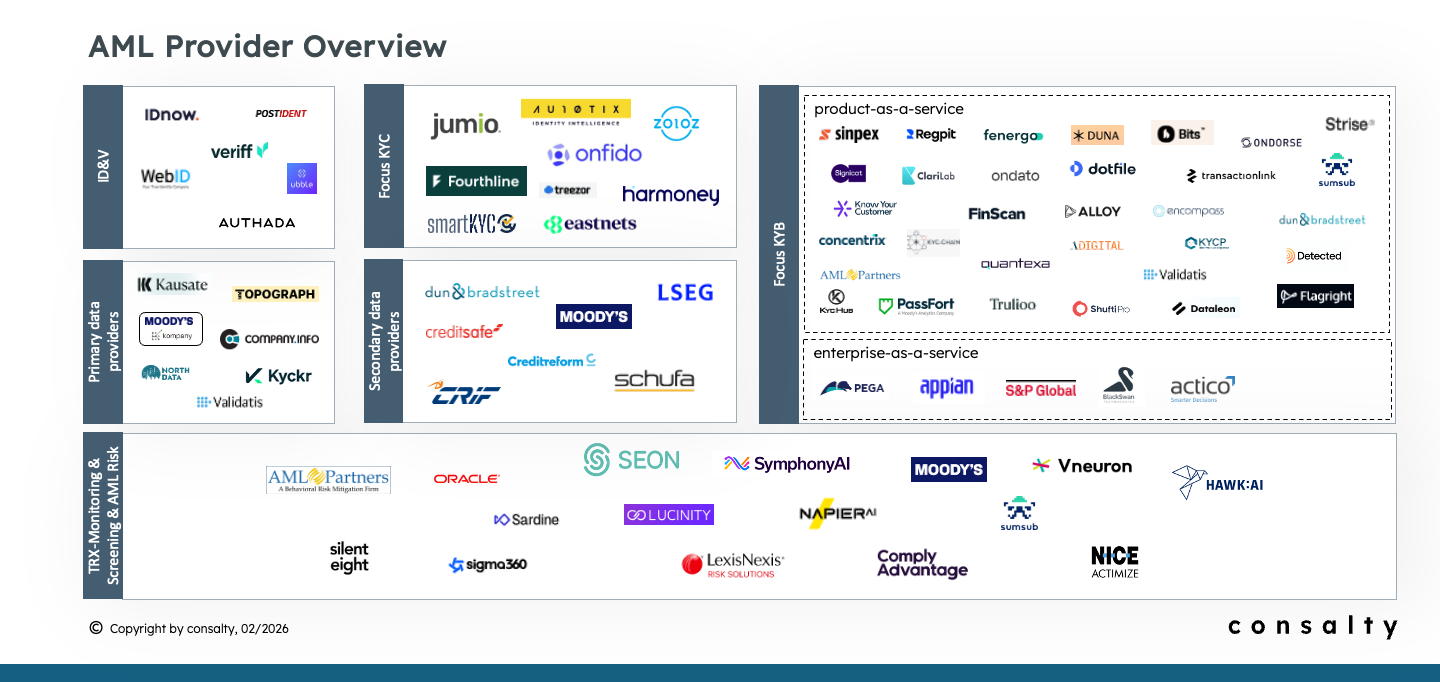
Our visualization shows six distinct categories – from ID&V providers to transaction monitoring platforms – each serving different operational needs.
Depending on the needs and capabilities of the obliged entity, it might be sufficient to select a data provider and an ID&V provider and build and run the workflow orchestration in-house. However, it is more common in the market to outsource a greater share of the value chain when it comes to KYB and select a ‘one-stop-shop-solution’ which integrates data provisioning, ID&V, screening, UBO calculation, workflow orchestration etc.
To make the selection process among these providers easier and more efficient, we identified three core criteria that can be used to further differentiate the providers in the KYB cluster from one another:
- Intelligent Document Handling: Providers that use Optical Character Recognition (OCR) automatically extract structured data from documents like Articles of Association or commercial registry extracts. This ensures the usage of primary data as opposed to secondary data where the data source and currency would need to be checked additionally by the obliged entity, especially when the AML regulation entries into force. For documents which need to be uploaded by the customer, the automatic extraction also significantly reduces onboarding time and manual error.
- Workflow Orchestration & Configurability: Some providers operate as true orchestration layers, allowing compliance teams to build modular, risk-based workflows in a self-service functionality that adapt to different jurisdictions, customer types, and escalation rules without heavy engineering input.
- Customer Lifecycle Management Support: Some providers offer so-called ‘fire-and-forget’ workflows which means that the KYC case is not stored in their solution but is deleted once the onboarding or review process has been finalized. If, however, an obliged entity intends to use the provider’s solution to manage the status and data of the customer during the entire customer lifecycle, a so-called CLM support is required. This necessitates a stateful solution that persistently stores KYC data, enables status tracking and updates over time, and supports compliant archiving once the customer relationship is terminated.
All three criteria need to be viewed with some caveats:
- Onboarding and re-KYC volumes must be assessed carefully: A high degree of automation comes at a cost and only becomes economically viable beyond a defined threshold of KYB transactions. Below that threshold, more manual solutions may be more efficient.
- Self-service workflow configuration should not be assumed as a default requirement: Self-service functionalities sound great in theory, but every workflow change still requires review and approval. In many cases, leveraging the service provider’s best practices and domain expertise delivers more value than continuously adapting workflows in a self-service model.
- Clear requirements are essential for effective provider selection: Without a good understanding of current and projected KYC volumes, risk distribution, legal entity types, geographic coverage, compliance and operations team size, and the role of adjacent providers (e.g. transaction monitoring), it is impossible to prioritise vendors effectively in an RfP. The result is often a solution that either over-engineers or under-serves the actual KYC needs.
In our visualization, we’ve structured the providers according to their service offering, helping decision-makers cut through the noise and identify tools that match operational and regulatory needs.
Our AML provider overview does not claim to be exhaustive. If you’re missing a provider or think we’ve misplaced someone, let us know! We’re continuously updating this landscape as a guidance for the AML compliance community.
Please note: This article does not replace legal or regulatory advice.
Would you like to discuss specifically how to select the right service provider or how you can best prepare for the AMLR? Contact us for a free initial consultation: info@consalty.com or linkedin.com/company/consalty/