

From July 10, 2027, the EU Anti-Money Laundering Regulation will replace the German Money Laundering Act. The common expectation: more data, more checks, more effort. This is true in many respects, but not everywhere. The German Banking Association (BdB) has answered 21 questions of interpretation regarding Articles 19 to 26 of the AML Regulation in its KYC industry standard. We have compared each of these 21 lines with the currently mandatory version, namely the German Money Laundering Act and the German Federal Financial Supervisory Authority's (BaFin) Interpretive Guidelines (AuA). The result: In ten lines, the standard is less stringent than what you currently have to do. Those who are aware of these points in good time can streamline their onboarding and customer relationship management processes more effectively than their competitors.
Important before you adapt your processes: The KYC industry standard reflects the interpretation of the banking association and is not legally binding. Supervisory authorities are also not bound by it, and it remains unclear in several respects whether BaFin and AMLA share this interpretation. Furthermore, some of the simplifications are not based on the standard at all. They arise directly from the regulation or the RTS on customer due diligence obligations, which may still change before its final version. Therefore, we indicate the source of each simplification.
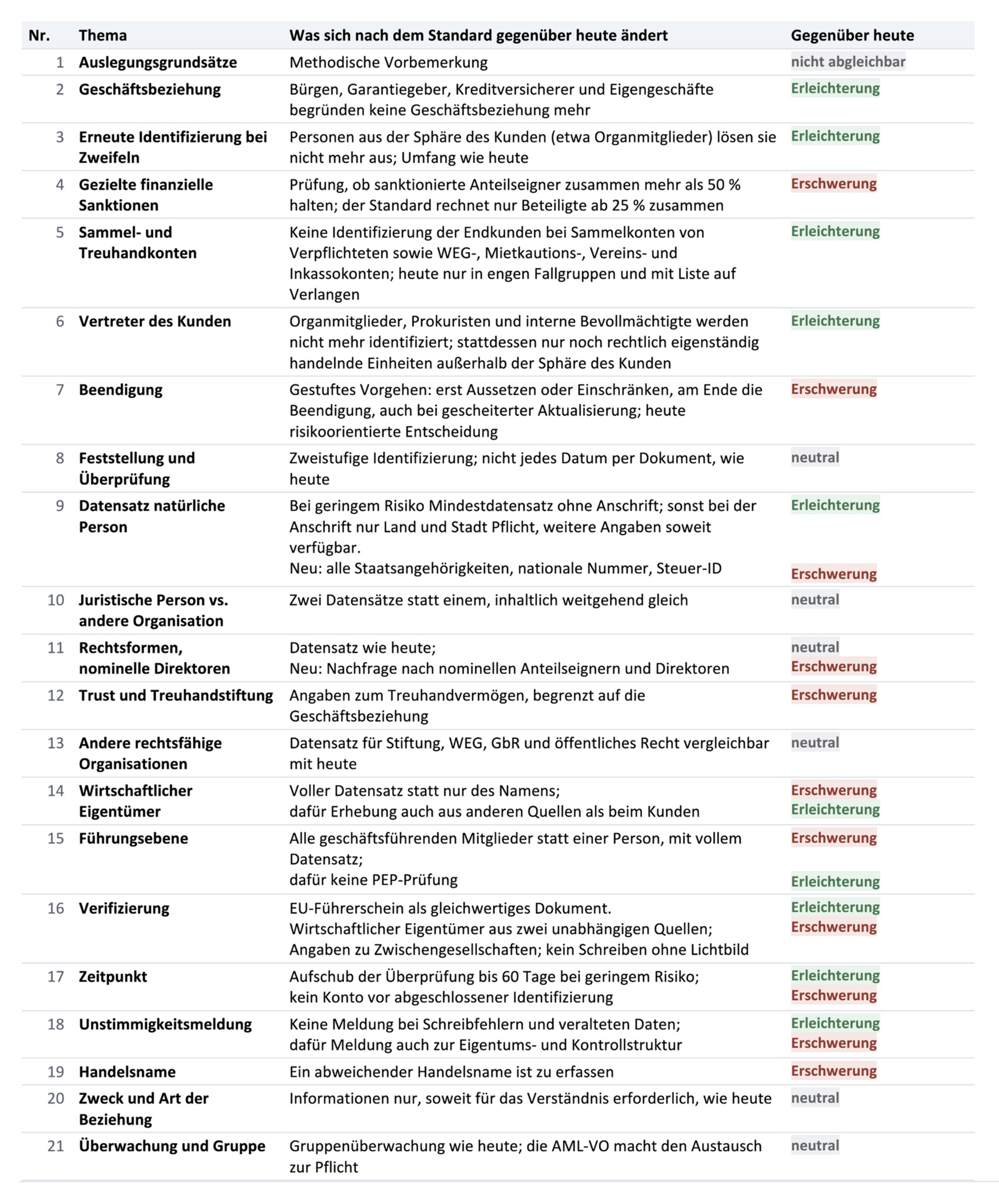
Overview of all 21 lines
By "today" we mean what is currently mandatory: the Money Laundering Act (GwG), the AuA (Austragsprüfungsgesetz – German Act on the Protection of Foreign Trade and Payments), and directly applicable EU law. If a line contains multiple statements, we evaluate each one individually.
Where it gets easier: the ten lines in detail
Line 2: Guarantors are no longer customers
Today, the guarantor is explicitly a contractual partner with all due diligence obligations (AuA AT Chapter 5.1.1). According to the standard, guarantors, surety providers, credit insurers, and proprietary transactions such as refinancing or hedging do not establish a business relationship. Only voluntary sanctions and adverse media screening is recommended.
Line 3: Doubt about the person, more narrowly defined
Section 10(3)(4) of the German Money Laundering Act (GwG) triggers re-identification even in cases of doubt regarding a person acting on behalf of the customer, without exception. The standard interprets Article 19(1)(f) of the AML Regulation to mean only persons acting independently alongside the customer, not employees or members of the customer's governing bodies. Furthermore, re-identification is required without a complete repetition of all due diligence obligations (unless new information emerges from the re-identification).
Line 5: Collective accounts beyond the current case groups
Today, BaFin permits simplified due diligence requirements for pooled escrow accounts only in narrow categories: school class funds, bowling clubs, residents of care homes and similar situations, debt collection agencies on a case-by-case basis, and customers who are themselves obligated entities under BaFin's supervision. Even then, the trustee must provide a list of beneficial owners upon request (AuA BT KI Chapter 7.2.1). According to the standard, the identification of end customers is not required for pooled accounts of all obligated entities and for condominium owners' association (WEG) accounts, rental deposit accounts, club accounts, and debt collection accounts. The draft CDD-RTS, however, is narrower: it requires that the account holder is themselves an obligated entity and provide information about their customers immediately upon request.
Line 6: Organ members are excluded from identification
Today, when establishing a business relationship, legal representatives and statutory agents must be identified, explicitly including members of the company's governing bodies (AuA AT Chapter 5.1.2). According to the standard, managing directors, authorized signatories, and internal representatives belong to the customer's sphere and are not "persons pretending to act on behalf of the customer." For corporate clients, this is the most significant simplification in the entire standard.
Line 9: Less data at low risk
Section 11(4) of the German Money Laundering Act (GwG) does not differentiate based on risk; even with simplified obligations, all due diligence requirements must be fulfilled, only their scope may be reduced (Section 14(2) GwG, AuA AT Chapter 6.2). Neither the GwG nor the AuA provide for a data record without a residential address. In the future, for low-risk situations, a minimum data record consisting of name, place of birth, date of birth, and nationalities, without an address, will suffice. Outside of low-risk situations, the country and city of residence are always mandatory; postal code, street, and house number remain mandatory, provided they are available.
Line 14: Beneficial owner from other sources
Today, the information must be obtained from the contractual partner; public sources, credit agencies, or the transparency register alone are not sufficient (§ 11 para. 5 GwG, AuA AT Chapter 5.2.3.2). According to the standard, the bank may also determine the beneficial owner from reliable and independent sources or via other obliged entities. This opens the way for register-based and automated determination, at least in the first stage.
Line 15: No PEP review of the management level
If no beneficial owner can be identified, the fictitious beneficial owner currently takes their place and is treated as such, including PEP screening and reporting pursuant to Section 24c of the German Banking Act (KWG) (AuA AT Chapter 5.2.2.2). According to the standard, both are omitted because, according to Recital 125 of the AML Regulation, the management level is not a beneficial owner.
Line 16: EU driving licence as identification document
Under general due diligence requirements, Section 12 Paragraph 1 of the German Money Laundering Act (GwG) requires a document that fulfills the identification obligation; a driver's license is currently only acceptable in cases of simplified obligations (AuA AT Chapter 6.2). According to the standard, an EU driver's license meets the criteria of an equivalent document under Article 22 Paragraph 6 of the AML Regulation. Because it does not specify the country of residence, further proof may be required.
Line 17: Review up to 60 days after justification
Today, identification may only be completed "immediately during the establishment of the business relationship" (§ 11 para. 1 sentence 2 GwG). In the future, if the risk is low, the verification of the customer and beneficial owner may follow up to 60 days after the relationship is established; however, identity verification must be completed beforehand. This creates genuine flexibility for digital onboarding processes.
Line 18: No discrepancy message for typos
Section 23a of the German Money Laundering Act (GwG) provides no exceptions; any deviation from the transparency register must be reported. In the future, banks may request customers to correct spelling errors, transliterations, minor inaccuracies, and outdated data instead of reporting them, provided there is no increased risk and the customer corrects the information within the specified timeframe.
Where it will nevertheless become stricter
The simplifications in the same processes are offset by additional effort, which the standard usually only mitigates:
- Sanctions check of shareholders (line 4): A new requirement is the check to see whether sanctioned persons together hold more than 50% (Art. 20 para. 1 lit. d AML Regulation). The German Money Laundering Act (GwG) and the German Act on the Protection of Shareholders (AuA) do not require this. The standard only aggregates shareholders holding 25% or more and argues that aggregating shares below this threshold is unnecessary – which in turn represents a relaxation of the strict interpretation.
- Condition (line 7): Here, the standard of the AML Regulation (Art. 21) applies, only allowing for suspension or restriction, as permitted by the draft AMLA guidelines on continuous monitoring (paragraphs 30 and 32). The new aspect is that a failed update also ultimately leads to termination; Section 10(9) of the German Money Laundering Act (GwG) does not currently cover this.
- Beneficial owner (lines 14, 16): Full data record instead of just the name; verification must generally be carried out using two independent sources; the transparency register alone is no longer sufficient (Art. 22 para. 7 AML Regulation). Currently, access to the transparency register is sufficient, but only if the information obtained from the customer matches and there are neither doubts nor indications of a higher risk (§ 12 para. 3 sentence 3 German Money Laundering Act); this includes information on intermediary companies.
- Management level (line 15): All executive members of the management body instead of one person, each with full data record.
- New data fields (lines 9, 11, 12, 19): All nationalities, tax ID, national number, nominal directors, details of trust assets, and any differing trade name. The standard usually allows a documented request for this information.
- Account opening (line 17): No account before completed identification, insofar as § 25j KWG still permits this today.
It's easy to overlook: In two instances, a bank adheres to the current standard, even though the AML Regulation requires more. Regarding the transparency register (line 16), Article 22(7) of the AML Regulation mandates a query for every review; the standard only requires it when establishing a business relationship. And regarding group data exchange (line 21), Article 16(3) of the AML Regulation makes the exchange mandatory, while the standard only requires it to be possible. Anyone following the association's interpretation in these instances should be able to provide a sound justification.
Conclusion: What this means for your processes
In summary, the comparison shows that the AML Regulation primarily shifts the burden. In the future, it will no longer be necessary to identify every representative, collect complete addresses, or report every deviation. However, the requirements regarding beneficial ownership and sanctions are significantly more detailed. Anyone currently developing their target framework should do three things. First, examine the ten simplifications and decide which ones fit their own risk profile. Second, document the simplifications that are based solely on the association's interpretation as acceptance and monitor supervisory developments. Third, consciously decide to adopt the two retractions of the standard, not simply because they are included in the standard.
Would you like to know how robust your own foundation is for AI projects? Feel free to contact us via
FAQ
Will KYC be stricter everywhere under the AML Regulation than under the Money Laundering Act?
No. Consalty compared the 21 interpretive questions of the German Banking Association's (BdB) KYC industry standard regarding Articles 19 to 26 of the AML Regulation with the current obligations under the German Money Laundering Act (GwG) and the BaFin interpretive guidelines: In ten lines, the standard is less stringent than the current situation. However, it becomes significantly stricter regarding beneficial ownership and sanctions. Ultimately, the AML Regulation, which will apply from July 10, 2027, primarily shifts the burden.
Is the KYC industry standard of the banking association legally binding?
No. The standard reflects the interpretation of the German Banking Association (BdB), and the supervisory authorities are not bound by it. Whether BaFin and AMLA share this interpretation is unclear in several respects. However, some simplifications arise directly from the AML Regulation or from the draft RTS on customer due diligence, which may still change before its final version.
Do managing directors and board members still need to be identified under the AML Regulation?
According to the BdB's KYC industry standard, managing directors, authorized signatories, and internal representatives are no longer considered "persons claiming to act on behalf of the client." Under the German Money Laundering Act (GwG), according to the BaFin's interpretive guidelines, members of corporate bodies must be explicitly identified when establishing a business relationship. This would represent the most significant relief for corporate banking, but it is based on the association's non-binding interpretation.
What KYC simplifications are available under the AML Regulation for low-risk cases?
For low-risk transactions, a minimum data set consisting of name, place of birth, date of birth, and nationalities, without address, will suffice. Furthermore, verification of the customer and beneficial owner may be carried out up to 60 days after the establishment of the business relationship; identity must be established beforehand. The Money Laundering Act (GwG) does not provide for either a data set without a residential address or this time limit.
Where will KYC be stricter under the AML Regulation?
This applies particularly to beneficial ownership and sanctions. A full data set is required, not just the name, and verification must generally be carried out using two independent sources; the transparency register alone is no longer sufficient. New requirements also include checking whether sanctioned individuals together hold more than 50% of the shares, recording all managing members of the board of directors, and adding data fields such as all nationalities and tax identification numbers.
Note: This article does not replace legal or regulatory advice.
also interesting