

Searching for AML technology in Europe can quickly feel like navigating a labyrinth. The market is fragmented and crowded: Dozens of service providers offer partially overlapping services under different names. Try searching for "KYC provider" on Google – the first page of results will show entries from completely different service categories. If you don't know exactly what you're looking for, it's easy to get lost.
From "KYB automation" to "risk engines" to "compliance orchestration", there is no uniform terminology – and it is precisely this lack of uniformity that makes it increasingly difficult for compliance teams to choose the right partner.
The confusion begins with basic definitions and requirements:
- KYB ≠ KYC: Know Your Customer, Know Your Business and Know Your Transaction are fundamentally different services – but are often bundled under one name.
- Engines, workflows, orchestration – what do you really need? Risk engines, workflow engines, and orchestration platforms sound compelling. But which components do you actually need?
- Operating in multiple jurisdictions? This means different registers, legal structures, documents, and data models. Ensure your AML provider truly understands the requirements in each country.
A lack of common standards not only makes comparing providers more difficult, but also creates concrete operational risks if institutions fail to assess a provider's performance in line with their own requirements.
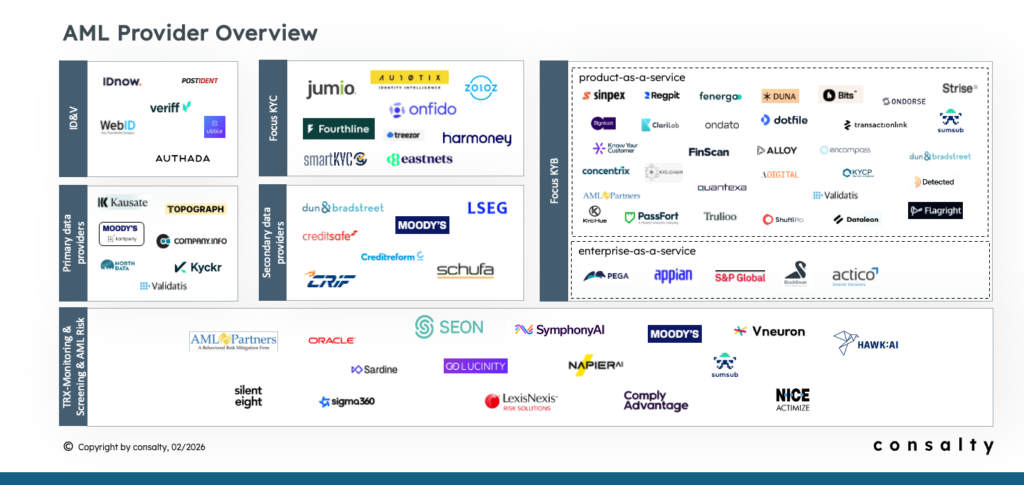
To reduce the complexity, we have mapped the European AML service provider landscape – here is the graphic as a PNG.
Our visualization shows six clearly separated categories – from ID&V providers to transaction monitoring platforms. Each category covers different operational requirements.
Depending on the needs and capabilities of the obligated party, it may be sufficient to select a data provider and an ID&V provider and to build and operate the workflow orchestration in-house. However, it is more common in the market to outsource a larger part of the KYB value chain and choose a "one-stop-shop" solution that integrates data provisioning, ID&V, screening, UBO calculation, workflow orchestration, and other components.
To make the selection between these providers simpler and more efficient, we have identified three key criteria. These help to differentiate between providers within the KYB cluster:
- Intelligent document processing: Providers with Optical Character Recognition (OCR) automatically extract structured data from documents such as articles of association or commercial register excerpts. This allows primary data to be used instead of having to additionally check secondary data for source and accuracy – especially when the AML regulation comes into force. For documents that the customer has to upload, automatic extraction also significantly reduces onboarding time and manual errors.
- Workflow orchestration and configurability: Some providers function as a true orchestration layer. They enable compliance teams to create modular, risk-based workflows in a self-service manner, which can be adapted to legal jurisdictions, customer types, and escalation rules without significant development effort.
- Customer Lifecycle Management (CLM) support: Some providers offer so-called "fire-and-forget" workflows. With these, the KYC case is not stored in their solution but deleted after onboarding or verification is complete. However, if an entity responsible for KYC wants to manage a customer's status and data throughout the entire customer lifecycle, CLM support is required. This necessitates a stateful solution that permanently stores KYC data, tracks status and changes, and supports compliant archiving after the business relationship ends.
All three criteria should be considered with some limitations:
- Carefully assess onboarding and re-KYC volumes: A high degree of automation incurs costs and only becomes economically viable above a certain number of KYC transactions. Below this threshold, more manual solutions can be more efficient.
- Don't automatically assume self-service workflow configuration: Self-service features sound attractive in theory, but every workflow change still needs to be reviewed and approved. In many cases, best practices and the provider's expertise create more value than constantly adjusting workflows yourself.
- Clear requirements are crucial: Without a good understanding of current and expected KYC volumes, risk distribution, legal structures, geographic coverage, the size of compliance and operations teams, and the role of related providers (e.g., transaction monitoring), it is impossible to meaningfully prioritize providers in a tender. Otherwise, the result is often a solution that is either oversized or insufficient to meet the actual KYC needs.
In our visualization, we have structured the providers according to their service offerings. This allows decision-makers to better understand the complex landscape and find tools that fit their operational and regulatory requirements.
Our AML provider overview is not exhaustive. Is a provider missing, or do you believe someone is incorrectly categorized? If so, please let us know.
Would you like to discuss how to select the right service provider or how to best prepare for the AML regulation? Contact us for a free initial consultation via
FAQ
What types of AML service providers are there?
In its overview of the European market, consalty distinguishes six categories, ranging from providers of identification and verification (ID&V) to platforms for transaction monitoring. Know Your Customer (KYB), Know Your Business (KYB), and Know Your Transaction (KYB) are fundamentally different services, even though providers often group them under a single term. In the KYB sector, many institutions rely on one-stop-shop solutions that integrate data provision, ID&V, screening, UBO (Unidentified Business Owner) detection, and workflow orchestration.
What criteria should be used to select a KYB provider?
Three criteria help in differentiating between them. First, intelligent document processing via optical character recognition (OCR), which extracts primary data directly from commercial register extracts or articles of association. Second, workflow orchestration that can be adapted to countries, customer types, and escalation rules via self-service. Third, support in customer lifecycle management, where KYC data is permanently stored and not deleted after onboarding.
Is a high degree of automation always worthwhile in KYB?
No. Automation only becomes cost-effective above a certain number of KYB cases; below that, manual solutions are often more efficient. A prerequisite for any provider selection is clear requirements: current and future KYC volumes, risk distribution, legal structures, geographic coverage, team size, and the role of related providers, such as for transaction monitoring. Without these, the result is often an oversized or inadequate solution.
Note: This article does not constitute legal or regulatory advice. All information is current as of February 2026.
also interesting